The Tenuous Folklore and Classification of Batman Hoverfly.
A couple of weeks ago, I wrote an article about Batman Hoverfly (Myathropa florea), covering its life cycle, geographical range and how to identify it in the field. If you haven’t read it, you can find it here.
It’s a hoverfly with a superhero emblem, buoyant larvae that dive like miniature whales, and a strong association with cemeteries.
The insect we know today as the Batman Hoverfly (Myathropa florea) is already one of Britain’s most distinctive hoverflies. Yet behind its comic-book nickname lies a far older and darker story.
Long before Batman existed, naturalists across Europe knew this species by another name: the Death’s Head Hoverfly.

Historical Classification
The taxonomic history of Myathropa florea is surprisingly tangled. When Carl Linnaeus first described the species in 1758, he named it Musca florea, literally a flower-visiting fly. Eighteen years later, however, Bavarian naturalist Franz von Paula Schrank saw something quite different.
In his 1776 work Beiträge zur Naturgeschichte, Schrank renamed the species Musca atropos. His description highlighted the three dark markings on the thorax that many observers believed resembled a skull or death mask.
 |
| Source: Internet Archive |
Original Latin
Musca Atropos. M.antennis fetariis, fubtomentoso; thorace albido, maculis tribus nigris; abdomine nigro, fasciis interruptis margineque fegmentorum flavis.
Translation
Musca Atropos. Fly with bristle-like antennae, slightly downy; thorax whitish with three black spots; abdomen black with interrupted bands and the margins of the segments yellow.
German description paragraph below reads approximately:
This fly is much larger than the common house fly (Musca vomitoria Linnaeus). It is common around Linz and also occurs near Regensburg. The face is white. The forehead bears a dark patch. The eyes are brownish red, the back black. The thorax is white and marked with three black spots, of which the middle one is elongated while the other two are rounded. The abdomen is black with interrupted orange-yellow bands. The legs are black. The wings are grey.
But why Atropos?
The name comes from Greek mythology. Atropos was one of the Three Fates, the sister whose role was to cut the thread of life.
Because of this association, the name became strongly linked with death and mortality. Naturalists frequently applied Atropos to animals bearing skull-like markings, the most famous example being the Death’s-head Hawkmoth (Acherontia atropos).
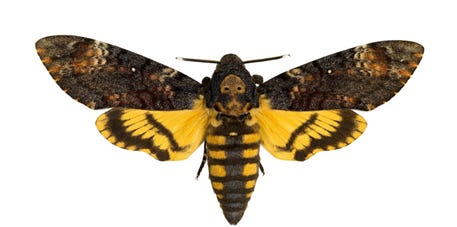
Wikipedia: Death’s-head Hawk moth - Dorsal side Collection of the Mathematician Laurent Schwartz
Schrank’s interpretation clearly resonated. More than two centuries later, versions of “Death’s Head Hoverfly” remained in use across much of Europe and still do.
German: Totenkopfschwebfliege (”Death’s Head Hoverfly”)
Dutch: known as Doodskopzweefvlieg or Doodshoofdzweefvlieg (”Death’s Head Hoverfly”).
French: called Syrphe tête de mort (”Death’s Head Hoverfly”)
Danish: named Dødningehoved-svirreflue (”Death’s Head Hoverfly”).
Swedish: referred to as Dödskallefluga (”Skull Fly”) or Dödskalleblomfluga (”Death’s Head Flower Fly”).
Norwegian: known as Daudinghovudblomsterfluge (Nynorsk, meaning “Dead-Man’s Head Flower Fly”).
Czech: called Pestřenka smrtihlavka (”Little Death-Head Hoverfly”).
Batman or Death’s Mask?
I must admit I don’t see this imagery myself.
Here are three images from books. What do you think Batman or Death Mask?

Sources: M.P.van Veen, Hoverflies of Northwest Europe (left) S. Stuart, B & Morris R 2024: Hoverflies of Britain and Ireland, Wildguides (middle) Stubbs A.E & Falk S.J British Hoverflies (right)
It may simply be that our perception has changed over time. Myathropa florea is a highly variable species, with individuals differing in size, colour and darkness of their markings. Maybe in the eighteenth-century naturalists saw death masks and fate, and in the 21st century observers now see superheroes, indicative of how culturally we have changed.
The story did not end with Musca atropos. Musca is the genus of flies that includes the common housefly, a group to which this hoverfly is clearly unrelated. It even had a brief time in the genus Helophilus (including the ‘Footballer’ – Helophilus pendulus), probably because of the similar thoraric markings. However, its eyes, wing venation, genitalia, larval morphology and more recent genealogy have shown they belong to distinct evolutionary lineages.
During the nineteenth century the species passed through several taxonomic revisions before Camillo Rondani placed it in the genus Myathropa in 1845.
But does the story end there…..
While researching the history of this hoverfly, I repeatedly encountered stories linking it to autumn, death and healing rituals. The connections are often vague and impossible to verify, yet they illustrate how easily a striking insect can become woven into local traditions.
I will share two such tenuous folklore myths that seemed more credible.
The Devil’s Curse and the Blackberry.
According to legend, when Lucifer was cast out of heaven, he fell from grace and landed directly into a thorny, blackberry bush. In his fury and pain, he cursed the plant and therefore on September the 30th the devil returns to spit on the berries – rendering them bitter, black and unfit to pick or be eaten for the rest of the year.
The fly’s appearance near these brambles around this time perfectly aligns the myth through proximal association. An insect with skull-like markings around overripe fruits heavily reinforced local superstitions, linking both the insect and the plant to bad omens and the dark decaying forces of autumn.
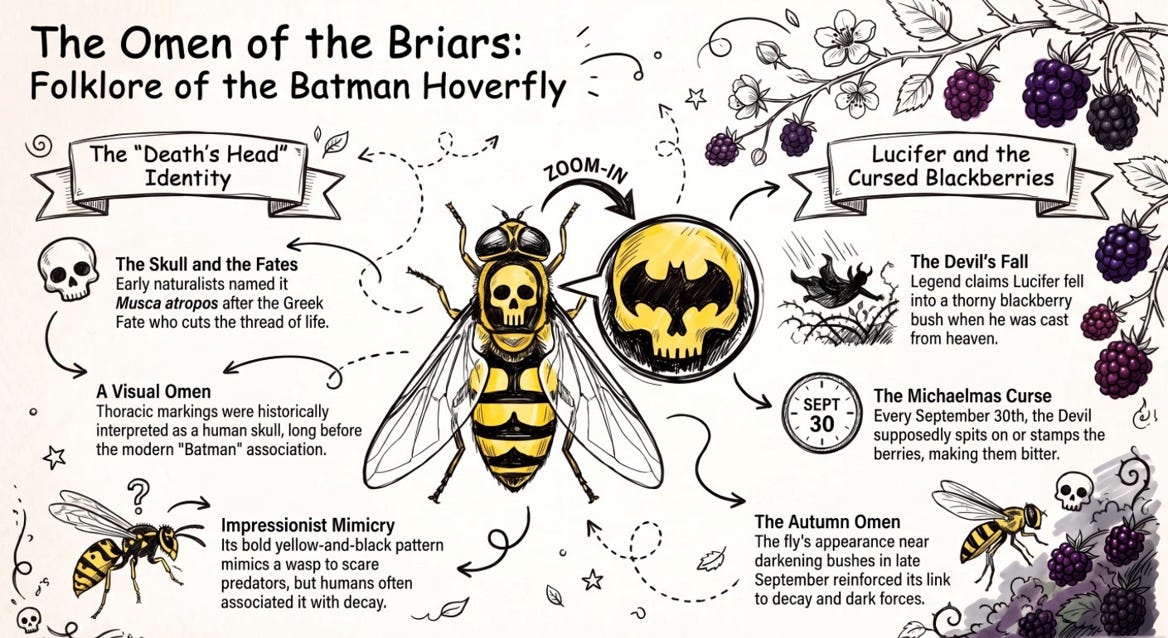
Herefordshire’s Briar Arch and Folk Medicine.
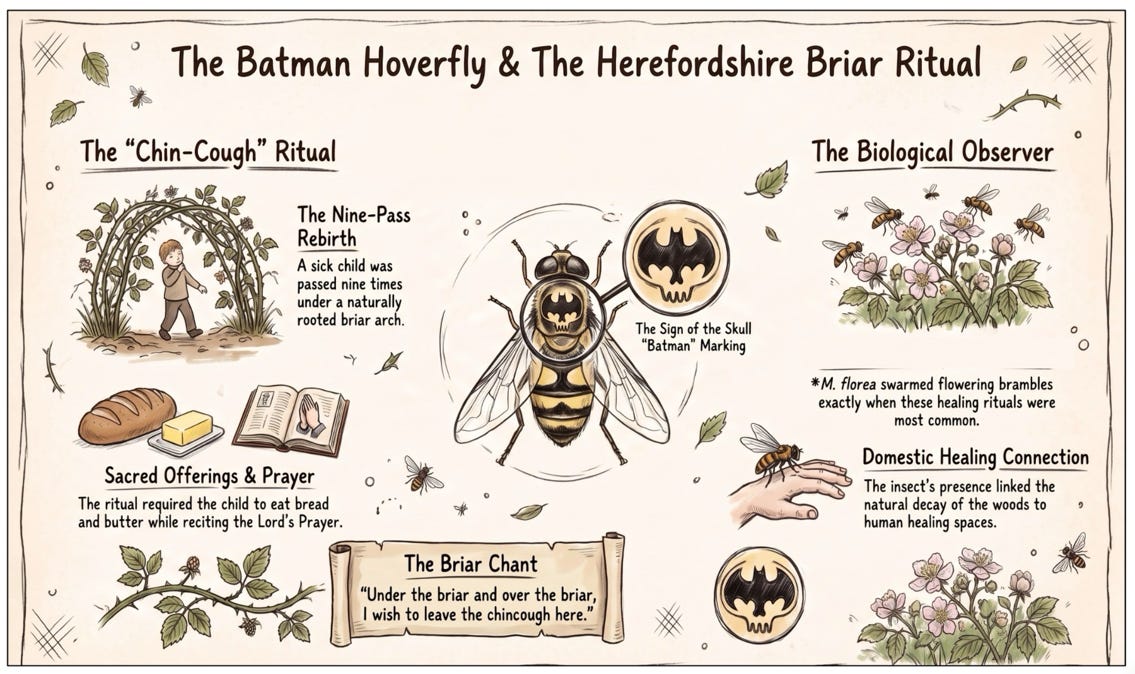
In this English county’s folk medicine, the bramble was symbolic of ‘rebirth and rituals to cure childhood illnesses – most notably Whooping cough, or as it was known regionally as ‘Chin cough’ To enact the cure the sick child was passed nine times under a naturally rooted arching bramble briar. The ritual required reciting the Lord’s prayer and chanting a traditional healing rhyme.
‘Under the briar and over the briar, I wish to leave the chin cough here’
Again, the presence of this hoverfly in the vicinity when performing such ritual associates, it with the lore, and subsequently it enters the journals of myth doesn’t it??
Let me know if you have come any of these myths in the comments below. I would love to hear from you if you have.
Behind every scientific name lies a human story and few hoverflies carry more intriguing tales than Myathropa florea: a species that has been a flower fly, a Death’s Head, and now, for many of us, Batman himself.
So, when you next encounter one basking on a leaf or hovering beside a woodland path, what do you see: the Batman or the face of Death?
Next Steps
If you enjoyed this article on hoverflies particularly the classification and mythical parts then you might like to try these posts next:
Historical and Hoverfly Culture
If you would like to read more about hoverfly species then try these posts next:
References
Franz von Paula Schrank (1747–1835) Beiträge zur Naturgeschichte (”Contributions to Natural History”) 1776 Beiträge zur Naturgeschichte : Schrank, Franz von Paula, 1747-1835 : Free Download, Borrow, and Streaming : Internet Archive
https://en.wikipedia.org/wiki/Acherontia_atropos
https://en.wikipedia.org/wiki/Laurent_Schwartz
https://theresagreen.me/2013/07/29/blackberry-bramble/
Click on the picture to Tip or Treat


No comments:
Post a Comment